
General Submission Guidelines
[8 June 2026: submission word limits increased for microfiction, flash fiction, and short story categories. Rights & Usage terms updated. Other language and consistency changes.]
Part 1: Quick Guide
New to submitting? Start here, and return occasionally to remind yourself of the submission process.
The following infographic summary cards cover the essentials, followed by a simple submission process flowchart. For full details, please read Part 2 before submitting.
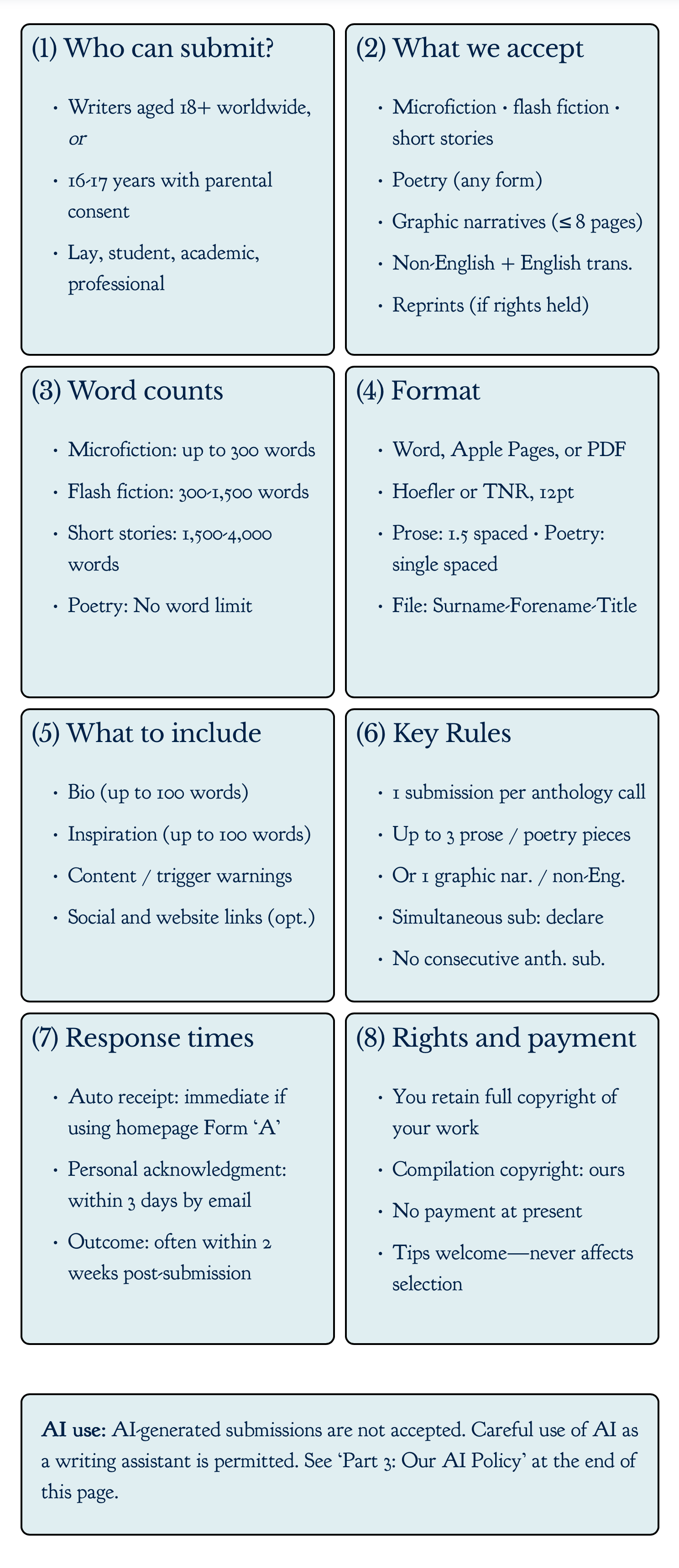
For full submission details, please read Part 2 before submitting.
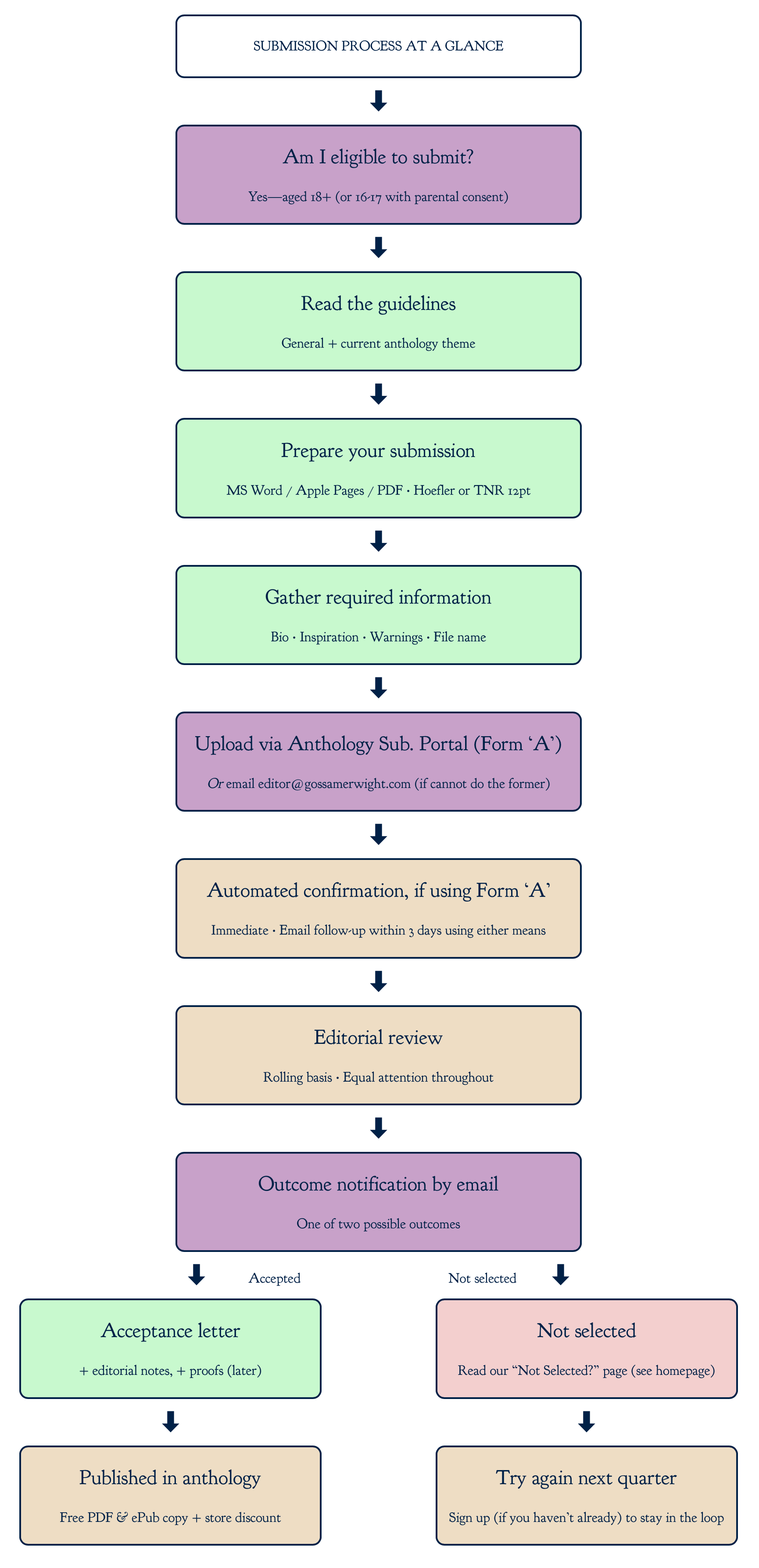
Part 2: Full Guidelines
Welcome
These guidelines explain how to submit prose, graphic narratives, poetry, or non-English work with an accompanying English translation, for our quarterly digital anthologies.
We publish theme-specific guidance for each anthology edition on our homepage, notify subscribers by email, and announce new submission windows on our social channels.
Please take a little time to read these guidelines before submitting. They set out what we accept, what we cannot accept, and how to submit your work.
Who can submit?
We welcome submissions from lay writers, academic writers, students of creative writing or English literature, professional writers, and established authors – based anywhere in the world.
We use British English by default, but will also consider submissions in other languages, provided a full and accurate translation accompanies them in British or American English.
Writers aged 16 or 17 may submit only with parental or guardian permission; otherwise, the minimum age is 18.
What we accept
Theme-appropriate work – to which you hold full rights – in the categories:
Microfiction.
Flash fiction.
Short stories.
Self-contained chapters or episodes from longer works.
Graphic narratives.
Poetry in any form (e.g., prose poetry, experimental work, fixed forms, and free verse), and
Non-English submissions with an accompanying English translation.
We accept reprints from personal websites, anthologies, literary magazines, defunct magazines, and print-only publications, but not work that has appeared on publicly accessible forums or social media.
We accept simultaneous submissions – please tell us when you submit, and let us know promptly if your work is accepted elsewhere.
We allow one submission per author per anthology: up to three prose or poetry pieces, or one graphic narrative, or one non-English submission with translation. We do not accept consecutive anthology submissions – if we accept your work in one quarterly issue, you must wait one issue before submitting again.
What we cannot accept
Work that does not fit the anthology’s theme.
Submissions sent after the submission window has closed.
AI-generated submissions.
Work that infringes copyright.
Work that breaches our general or theme-specific guidelines.
We will not publish material that contains gratuitously explicit sexual content, sexual violence, fetishised suffering, graphic cruelty to children or animals, purposeless violence or gore, hate speech, dehumanising propaganda, glorification of real-world abuse or crime, defamatory material, or anything illegal. Violence, trauma, and difficult themes may appear in submissions, but they must serve a serious literary purpose and be handled with care.
Rights & usage (general)
When we accept your work for publication, we acquire the rights we need to include it in a specific quarterly digital anthology. In practice, this means we may edit, publish, and promote your work within the anthology and across our website and social channels – we will not use it for any other purpose without your consent. Each anthology is made available to download from our online store as a PDF and ePub.
For previously unpublished work, we acquire first serial rights: in plain terms, the right to be the first periodical to publish it. By submitting, you confirm that the piece has not previously appeared in another magazine, journal, or similar publication. If you are submitting simultaneously and your work is accepted elsewhere before we publish it, please let us know as soon as you can—we will withdraw the piece from consideration rather than proceed.
For reprints, we ask only that you hold the rights to allow republication – for example, that the original publisher’s licence was non-exclusive, or that those rights have since reverted to you.
In both cases, your work will remain permanently accessible in our online store as part of the anthology in which it appears.
We ask for exclusivity only until the point of publication. Once your work is available to download in our store, you are free to republish it, license it elsewhere, or include it in your own collection – without needing to ask us first.
You retain full copyright in your work throughout. We retain copyright in the anthology compilation as a whole.
If you are unsure about any rights matter, please get in touch before submitting: editor@gossamerwight.com.
Length, format, and file details
Please submit your work as a Microsoft Word, Apple Pages, or PDF file – PDF is often the best choice for poetry, as it preserves layout and typography.
Use Hoefler if you have it; otherwise Times New Roman, 12-point throughout. Prose should be one-and-a-half spaced with standard margins; poetry single-spaced. If your poem depends on a particular layout, please present that layout intact.
Graphic narratives should function as self-contained stories and remain legible at our anthology size of A5 (148 x 210 mm / 5.83 x 8.27 inches) – we may reduce panels to fit, so please bear readability in mind.
Word counts: microfiction up to 300 words; flash fiction 300–1,500 words; short stories 1,500–4,000 words; graphic narratives up to eight pages (subject to the needs of the piece); poetry has no fixed word limit. We may change word limits in future anthology editions; please revisit these guidelines each time you want to submit to ascertain current word count limits.
Please name your file in the format Surname-Forename-Title before uploading.
We may make minor spelling, grammar, and other editorial changes to submitted work, in consultation with you where appropriate.
Original Artwork Guidelines
Distinct from our requirements for graphic narrative submissions, we also consider original artwork to accompany general prose, poetry, or non-English submissions with an accompanying translation.
Acceptable Art:
Format: Grayscale (black and white) only. Colour artwork will not be accepted.
Creation Method: Original hand-drawn or hand-painted artwork (traditional or digital). Digital pieces must be created manually by the artist (e.g., using a stylus or tablet).
Exclusions: We do not accept photographs, stock images, or any AI-generated/AI-assisted imagery.
Submission Format:
Individual PNG files at 300 DPI resolution.
Files must be attached separately; do not embed images in Word, Pages, or PDF documents.
Recommended naming convention: LastName_FirstName_Title_Artwork.png
Rights & Usage:
You keep full copyright over your artwork – submitting it to us does not transfer ownership to GossamerWight in any way.
By submitting, you give us the right to include your artwork in the specific anthology for which it is accepted. As stated under Rights & usage (general), GossamerWight holds rights to each anthology as a compiled collection – including the right to publish, distribute, and sell the volume – but this does not affect your ownership of the individual artwork itself.
As with written work, we ask for exclusivity only until the anthology is published and available to download in our store. After that point, you are free to use, license, or exhibit your artwork elsewhere without needing our permission.
All submitted artwork is subject to editorial review. We may exclude a piece, make minor adjustments for print optimisation, or use an alternative if the submitted file cannot be used in the final publication.
If you are unsure whether your artwork meets our criteria, please get in touch before submitting: editor@gossamerwight.com.
How to submit
Please upload your work through the Anthology Submissions Portal (Form ‘A’) on our homepage. If the portal is unavailable, you may email your submission to editor@gossamerwight.com.
Each submission to include: a short writer’s bio (up to 100 words); the inspiration for your piece(s) (up to 100 words); any content or trigger warnings; social media or website links (optional); and a correctly named file.
Please send all pieces for the same submission together in one go. If anything remains unclear after reading these guidelines and the theme-specific guidance, please contact us before submitting – we are always happy to clarify.
What happens next
We acknowledge all submissions received during the open window – see ‘More on response times’ below for full details.
Our editorial team is small, so we cannot offer individual feedback on submissions we do not accept. If your submission is not selected, please read our ‘Not Selected? Read Me’ page.
We make our selection decisions on a rolling basis throughout the open window, emailing all submitters the outcome using the address they provided.
Once the latest anthology is published, we announce it by email to subscribers and on our social channels. Our quarterly anthologies are available to download from our store in PDF and ePub formats.
More on response times
Form ‘A’ submissions: you will receive an immediate automated email confirming successful submission, with an additional personal acknowledgement from an editor within three days, confirming safe receipt and download.
Email submission (to editor@gossamerwight.com, if Form ‘A’ cannot be used): you will receive a personal acknowledgement from an editor within three days, confirming safe receipt and download.
Submission outcome: we aim to notify you of the outcome approximately two weeks post-submission. Those submitting early in the window may hear sooner; those submitting close to the deadline may hear up to two weeks after the window closes.
Payment
We cannot offer payment for accepted submissions at present. Tips are welcome but entirely optional and do not affect selection.
Voluntary fees: we accept voluntary fees (‘tip jar’ payments) for all submission types. Should you wish to tip, please use our Buy Me A Coffee link below. Thank you!

Part 3: Our AI Policy
Generative AI appears here to stay. If you have used tools such as ChatGPT, Perplexity, or Microsoft Copilot, you will know they can be useful, but also imperfect. Whether AI deepens creativity or dulls it, one thing is certain: its use must be guided by care, honesty, and responsibility.
For submissions to GossamerWight Literary Magazine, including our anthologies, we ask writers to keep the following in mind:
Our guiding principles
We want to read your work, and to hear your voice.
Keep it original. Your prose, graphic narrative, or poetry should be your own, shaped by your own ideas and style. AI may help at the beginning, but it should support your writing, not replace it.
Use AI carefully. AI can be inaccurate or irrelevant, so do not rely on it without checking against reliable non-AI sources.
Respect copyright. We do not accept work that appears to copy or infringe another creator’s rights.
Acceptable uses of AI
Acceptable AI uses include:
Generating ideas. AI may help spark plot, character, or setting ideas.
Refining language. After your own editing, AI may help with clarity, style, grammar, punctuation, and spelling.
Supporting research. AI may be used as a secondary research tool.
Offering early feedback. Tools such as Grammarly or ProWritingAid can help identify places to improve.
Use AI as an assistant, not an author. The finished work should still sound unmistakably like you.
❦
(Image credit (top): Yusuf Evli from Unsplash. Image credit (bottom): Poster for the 1927 film Metropolis. Boris Bilinski. Fritz Lang. Wikimedia Commons).
_Plakat_f%C3%BCr_den_Film_Metropolis_(2).jpg)